-
Saving for College: Using 529 Plans Effectively in 2025

The cost of higher education continues to rise, making it important for families to explore savings options that can help them manage future expenses. One widely used approach is the 529 plan, a tax-advantaged savings account designed specifically for education costs. Using 529 plans effectively can help you plan for short- and long-term education and investment goals.
Understanding 529 Plans
A 529 plan is a state-sponsored education savings program that offers tax advantages when funds are used for qualified education expenses. There are two main types of 529 plans: education savings plans and prepaid tuition plans.
- Education Savings Plans: These allow you to invest in a variety of financial assets, such as mutual funds, with the goal of growing savings over time. The funds can be used for tuition, fees, books, and other education-related expenses at eligible institutions.
- Prepaid Tuition Plans: These plans let you purchase future tuition at current prices, typically limited to in-state public institutions. Some states offer conversion options for private or out-of-state colleges.
Each state administers its own 529 plan, and while residency may affect eligibility for state tax benefits, funds can typically be used at institutions nationwide.
Tax Benefits and Contribution Considerations
One of the main benefits of 529 plans is tax-free growth when funds are used for qualified education expenses. Contributions are made with after-tax dollars, but the earnings grow tax-free at the federal level, and in many cases, at the state level as well.
Some states offer tax deductions or credits for contributions, which can provide additional savings opportunities. However, contribution limits vary by plan and state, so it is helpful to review state-specific guidelines when determining a savings strategy.
Using a 529 Plan for K-12 and Higher Education Expenses
529 plans were originally designed for college savings, but have expanded in recent years to cover other education expenses. You can now use funds for K-12 tuition at private and religious schools, with an annual limit of $10,000 per student. Additionally, up to $10,000 can be used to repay student loans for the beneficiary and their siblings.
When planning for college, you should consider eligible expenses, including tuition, room and board, mandatory fees, books, and computers. It is important to review each school’s cost structure to determine how savings will be applied.
Related: Back-to-School Financial Planning: Managing Education Costs
Investment Strategies for 2025
529 plans offer a range of investment options, often including age-based portfolios that adjust risk levels as the beneficiary nears college age. Plans for younger children typically have more exposure to equities for potential growth, while plans for older students transition to more conservative investments.
If you are starting to save in 2025, factors such as inflation, market conditions, and interest rates may influence investment choices. Some people may prefer diversified options, while others may look for stability in conservative portfolios.
Regularly reviewing investment performance and adjusting contributions can help align savings goals with expected expenses. Many plans allow for changes to investment allocations twice per year, which can be adjusted based on financial circumstances.
What Happens if the Beneficiary Doesn’t Use the Funds?
If the original beneficiary does not use the funds, you have several options. One approach is to change the beneficiary to another eligible family member, such as a sibling, cousin, or even a parent returning to school. Funds can also be used for graduate school or rolled over into a 529 ABLE account for individuals with disabilities.
As of 2024, account holders can roll over unused 529 funds into a Roth IRA under certain conditions. This new option provides additional flexibility, allowing you to repurpose savings without penalties, subject to contribution limits and eligibility requirements.
If funds are withdrawn for non-qualified expenses, earnings are subject to income tax and a 10% penalty. Reviewing options before withdrawing can help minimize tax implications.
Comparing State Plans and Choosing the Right One
Each state offers its own 529 plan, and you do not have to choose the one from your state of residence. Some states provide additional tax incentives or lower fees, which may make certain plans more attractive.
When evaluating options, key factors include:
- Investment choices and performance history
- Management fees and administrative costs
- State tax benefits and contribution limits
- Flexibility in fund usage
Researching different plans and comparing their features can help you select an option that aligns with your financial goals.
Incorporating 529 Plans into a Broader Education Savings Strategy
While 529 plans provide valuable tax benefits, they are one part of a broader education savings strategy. You could also consider custodial accounts, Coverdell Education Savings Accounts, or traditional investment accounts, depending on your financial situation and goals.
Some families use a combination of savings vehicles to maintain flexibility, especially if they anticipate funding expenses beyond tuition and fees. Discussing options with a financial professional may provide additional insight into balancing savings and investment approaches.
Planning for Withdrawals and Managing Expenses
As college approaches, you should develop a withdrawal strategy to avoid unexpected tax consequences. Qualified withdrawals should be matched with eligible expenses in the same tax year to maintain tax-free status.
Some schools allow direct payment from 529 accounts, while others require reimbursement to the account holder. Keeping detailed records of expenses can help ensure compliance with tax rules.
Using 529 Plans Effectively: The Bottom Line
529 plans remain a useful tool for education savings in 2025, offering tax advantages and investment flexibility. If you are looking to save for college or other educational expenses, it’s important to understand your options, compare plans, and develop a strategy that aligns with your financial goals. Regularly reviewing your contributions and investment performance can help you adapt to changing circumstances and education costs.
Illuminated Advisors is the original creator of the content shared herein. I have been granted a license in perpetuity to publish this article on my website’s blog and share its contents on social media platforms. I have no right to distribute the articles, or any other content provided to me, or my Firm, by Illuminated Advisors in a printed or otherwise non-digital format. I am not permitted to use the content provided to me or my firm by Illuminated Advisors in videos, audio publications, or in books of any kind.
-
College Student Financial Tips for the Young People in Your Life
How to Help a New College Student Prepare for Success
The first semester of college is an exciting time, and the perfect moment to pass along financial tips for your new college student. Oftentimes, it’s the first chance young people have to leave the nest, spread their wings, and experience the ups and downs that come with financial freedom.
Your kids have come a long way from the days of the tooth fairy and piggy banks as fiscal cornerstones. It’s critical that young people enter into this next stage of life with everything they need to not only succeed academically, but financially, too. The college student financial tips below are helpful topics to discuss with the new college students in your life to help them start off on the right foot.
Tip #1: Learn Budgeting Basics
There are many different ways to budget and prioritize. You can give your child a big advantage by sitting down and coming up with a reasonable and realistic financial plan for fixed items, extracurriculars, academic needs, and even an emergency fund to prepare for the unexpected.
Then determine the best way to keep track of the budget. There are several apps loaded with features that can make it easy to stay on track. Or, if your college student is a fan of spreadsheets, they can put their math skills to good use with some easy formulas and templates. Better yet, see if they can sign up for a budgeting, financial skills, or economics course that can help integrate their personal and academic goals.
Tip #2: Be Wary of Borrowing
Student loans are a staple of college education financing for many students these days. But even though they’re available, it pays to be wary of how much you borrow and how you use the funds. Though there are plenty of temptations in campus life—spring break, shopping, or late-night pizzas—student loan dollars should only be used for tuition, books, and necessary living expenses.
Depending on how savvy your child is with financial situations, you may want to suggest that you help take them through the loan paperwork before they sign it. Student loan debt in the United States totals a whopping $1.75 trillion dollars, and the average U.S. household with student debt owes $62,913. So, it’s important to be clear that there’s a lot on the line.
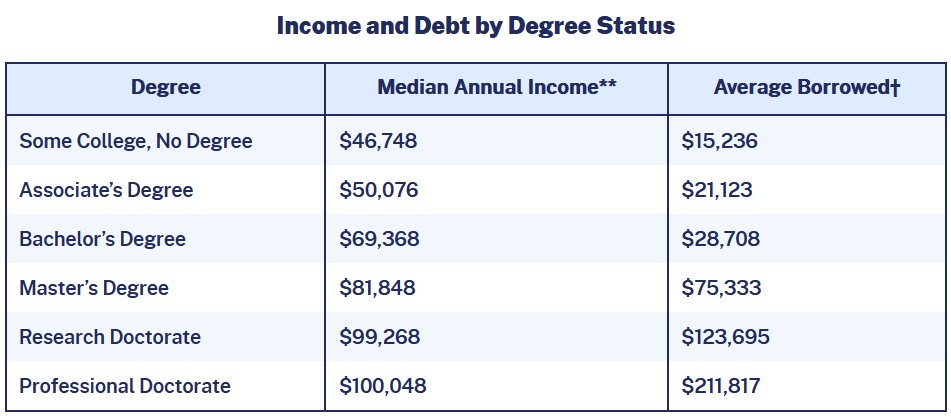
SOURCE: www.educationdata.org *Among workers aged 25 years and over; based on average weekly earnings of full-time wage and salary workers.
†Cumulative student loans only (no Parent PLUS); data collected between 2015 and 2018, currency inflated to 2021Q2 values to match income data collection period; amount borrowed is not equivalent to current debt.Tip #3: Prioritize Education
We want our kids to make the most of college on the academic front, but we also hope that it’s a fun and enjoyable time in their lives. It’s a new and exciting environment, and often the first chapter of their lives in which they are able to branch out on their own and discover who they are and what they want out of life. Of course, life is about balance, and new students need to walk the line between the call of adventure and important academic obligations. Falling behind can quickly lead to failing a class. Not only will that hurt their academic standing, but if they have to make up the class, they’ll likely have to pay for it again.
Tip #4: Credit Is Complicated
Credit cards can seem a bit like an “easy button” for young people tempted by the latest fashions, technology, and experiences. Fortunately, by law, credit card companies aren’t permitted to market on college campuses or issue cards to anyone under 21 without proof of income or an adult cosigner.
You can, of course, add your child to your card as an authorized user, but be sure to limit use to emergencies only and discuss the dangers of high-interest debt.
Tip #5: Live by the Textbook
Textbooks are notoriously expensive—over the course of a college career a student can easily exceed thousands of dollars on textbooks alone. Buying used books can save some funds, as can sharing costs with a study partner who is in the same class. Renting is also an option—there are plenty of companies online that will let you rent or borrow books one semester at a time for a much lower price point. Make certain your student knows that buying new isn’t the only option.
Tip #6: Master the Basics
Your child may be book smart, but often the biggest life lessons aren’t covered in school. Make sure your new college student has a good grasp of basic living skills. Teach them how to cook on a budget instead of ordering food out. That one habit alone can save them thousands of dollars. Encourage them to carpool or take public transportation instead of relying on cabs or Uber. Making sure they do their own laundry can also ensure their clothes last for years instead of months. These may sound like basic life skills instead of college student financial tips but, when combined, they can help your child prepare for a successful college career and a financially responsible life ahead.
College Sets the Course
Your child’s college years are consequential on several fronts. How your new college student does in their academic career can have a big impact on their career prospects, of course, but there’s more to it. Looking beyond grades, it’s also a time during which they discover who they are and what they’re made of. Giving sound advice can help them feel confident and accomplished and set them up for a future they (and you) can be proud of. So, use these financial tips for your new college student to help them chart a successful course through college and beyond.
If you think you would benefit from a conversation about personal finance or broader financial planning topics, contact Lane Hipple Wealth Management Group at our Moorestown, NJ office by calling 856-638-1855, emailing info@lanehipple.com, or to schedule a complimentary discovery call, use this link to find a convenient time.
Illuminated Advisors is the original creator of the content shared herein. We have been granted a license in perpetuity to publish this article on our website’s blog and share its contents on social media platforms. We have no right to distribute the articles, or any other content provided to our Firm, by Illuminated Advisors in a printed or otherwise non-digital format. We are not permitted to use the content provided to us or my firm by Illuminated Advisors in videos, audio publications, or in books of any kind.