-
5 Ways a Financial Advisor Can Help You Prepare for Tax Season

A Strong Tax Strategy is Part of a Thoughtful, Comprehensive Financial Plan
Tax season is upon us and, while not every financial advisor is a Certified Public Accountant (CPA), that doesn’t mean they can’t be helpful. Your financial advisor can assist you with making strategic tax moves throughout the year to help reduce your overall tax burden. As you read below, keep in mind that the sooner you begin having these conversations with your advisor about your tax strategy, the better off you’ll be at tax time.
Finding Ways to Maximize Your Tax Savings
There are many financial moves you can make throughout the year that will result in paying lower taxes, and a financial advisor will be educated about them. For example, some investment accounts let you make tax-deferred contributions, which can offer you the opportunity to save money on taxes while working to build your retirement savings. Take a company-sponsored 401(k), for instance. If you max out your contributions to this account, all of the money going in is pre-taxed, so you’ll be putting money away for retirement while reducing your tax bill in the present.
Keeping Record of Your Capital Gains and Losses
When filing your taxes, you’ll have to know how much you earned and lost from your investments for that year. A financial advisor will have an accurate and consistent record of your investments, which they can give to your accountant on your behalf. This will save you time and energy, and help you ensure you’re paying appropriate capital gains tax, without over-paying.
Developing a Tax-Savvy Gifting Strategy
There’s a lot to be gained when we gift our money to others. Not only do you get the intrinsic rewards associated with the joy and meaning that comes from helping others, but you can enjoy valuable tax benefits, too. Sit down with your financial advisor and discuss how you can gift your money in ways that ultimately help lower your tax bill, too. And this isn’t just for charities; if you want to give money to your family members for any reason, there are plenty of gifting strategies that let you transfer your wealth without a tax penalty. Check-in with your financial advisor before making any gifts so you can be sure to maximize the opportunity.
8 Considerations For Passing an Inheritance To Your Children
Minimizing the Tax Burden that RMDs Bring
Once you reach the age of 73, you’ll have to begin taking out Required Minimum Distributions (RMDs) from any IRA or 401(k) accounts that you have. While this comes as no surprise, often the uptick in your tax bill from having to pay income tax on those distributions does come as a surprise to retirees. A financial advisor will be able to provide you with management strategies so that you can lower your tax liabilities and be more prepared when the time comes to begin taking distributions.
Determining Tax-Efficient Investment Strategies
Although a financial advisor can’t necessarily protect you from capital gains tax, they will be able to help you by implementing strategies such as tax-loss harvesting, offsetting gains with losses, and avoiding issues such as “phantom tax,” which limit your overall tax liability. So, they’ll not only be able to help you manage and balance a portfolio, but they’ll be able to ensure you’re following the best investment strategies to benefit you the most when it comes time to file your taxes.
Do You Need a Financial Advisor to Assist with a Tax Strategy?
The world of taxes can be incredibly confusing, especially considering they’re constantly changing depending on the economy and new legislation. Having a financial advisor you trust is an important addition to your tax planning arsenal. A financial advisor can guide you throughout the year to ensure you’re making the best financial choices to help boost your tax strategy, with the ultimate goal of allowing you to save more of your hard-earned dollars.
If you think you would benefit from a conversation about your tax strategy, contact Lane Hipple Wealth Management Group at our Moorestown, NJ office by calling 856-638-1855, emailing info@lanehipple.com, or to schedule a complimentary discovery call, use this link to find a convenient time.
Illuminated Advisors is the original creator of the content shared herein. I have been granted a license in perpetuity to publish this article on my website’s blog and share its contents on social media platforms. I have no right to distribute the articles, or any other content provided to me, or my Firm, by Illuminated Advisors in a printed or otherwise non-digital format. I am not permitted to use the content provided to me or my firm by Illuminated Advisors in videos, audio publications, or in books of any kind.
-
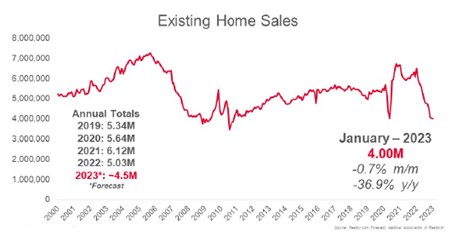
Existing Home Sales Drop for 12th Straight Month, Lowest Since 2010

On Tuesday, the National Association of Realtors reported that existing-home sales fell for the 12th straight month in January. In addition, month-over-month sales were mixed among the four major U.S. regions, as the South and West registered increases, while the East and Midwest experienced declines. All regions recorded year-over-year declines.
Housing Highlights
- Existing-home sales waned for the twelfth consecutive month to a seasonally adjusted annual rate of 4.00 million. Sales slipped 0.7% from December 2022 and 36.9% from the previous year.
- The median existing-home sales price increased 1.3% from one year ago to $359,000.
- The inventory of unsold existing homes grew from the prior month to 980,000 at the end of January, or the equivalent of 2.9 months’ supply at the current monthly sales pace.
Bottoming Out?
“Home sales are bottoming out. Prices vary depending on a market’s affordability, with lower-priced regions witnessing modest growth and more expensive regions experiencing declines. Inventory remains low, but buyers are beginning to have better negotiating power.
Homes sitting on the market for more than 60 days can be purchased for around 10% less than the original list price.”
- The median existing-home pricefor all housing types in January was $359,000, an increase of 1.3% from January 2022 ($354,300), as prices climbed in three out of four U.S. regions while falling in the West.
- This marks 131 consecutive months of year-over-year increases, the longest-running streak on record.
- Properties typically remained on the market for 33 days in January, up from 26 in December and 19 in January 2022. 54% of homes sold in January were on the market for less than a month.
Location, Location, Location- Existing-home sales in the Northeast retracted 3.8% from December, down 35.9% from January 2022. The median price in the Northeast was $383,000, up 0.3% from the previous year.
- In the Midwest, existing-home sales slid 5.0% from the previous month, declining 33.3% from one year ago. The median price in the Midwest was $252,300, up 2.7% from January 2022.
- Existing-home sales in the South rose 1.1% in January from December, a 36.6% decrease from the prior year. The median price in the South was $332,500, an increase of 3.4% from one year ago.
- In the West, existing-home sales elevated 2.9% in January, down 42.4% from the previous year. The median price in the West was $525,200, down 4.6% from January 2022.
Sources: nar.realtor
Copyright © 2023 MainStreet Journal. All rights reserved
Distributed by Financial Media Exchange. -
Conference Board Leading & Coincident Economic Indicators Pointing to a Recession

The Conference Board was founded in 1916 by a group of CEOs “concerned about the impact of workplace issues on business, and with a desire for greater cooperation and knowledge sharing among businesses.”
Every month, the Conference Board compiles a composite of economic indexes designed to signal peaks and troughs in the business cycle. The leading, coincident, and lagging economic indexes are essentially composite averages of 10 individual indicators and help smooth out some of the volatility of individual components.
The ten components include:
- Average weekly hours, manufacturing
- Average weekly initial claims for unemployment insurance
- Manufacturers’ new orders, consumer goods and materials
- ISM Index of New Orders
- Manufacturers’ new orders, nondefense capital goods excluding aircraft orders
- Building permits, new private housing units
- Stock prices, 500 common stocks
- Leading Credit Index
- Interest rate spread, 10-year Treasury bonds less federal funds
- Average consumer expectations for business conditions
Leading Indicators Signaling a Recession
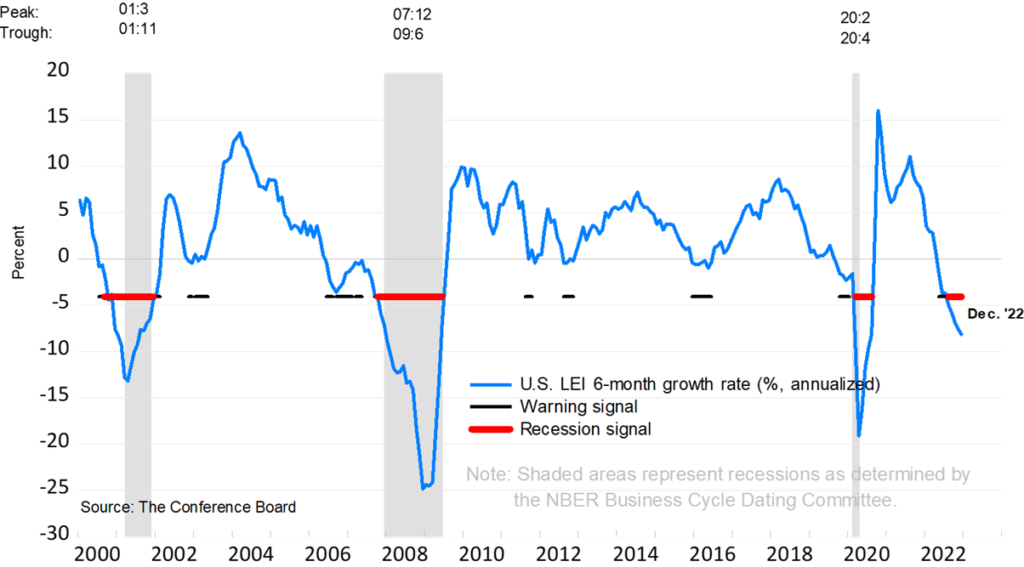
On January 23rd, the Conference Board announced that its Leading Economic Index for the U.S. decreased by 1.0% in December 2022 to 110.5 (2016=100), following a decline of 1.1% in November.
The LEI is now down 4.2% over the six-month period between June and December 2022 – a much steeper rate of decline than its 1.9% contraction over the previous six-month period (December 2021–June 2022).
“The US LEI fell sharply again in December – continuing to signal recession for the US economy in the near term. There was widespread weakness among leading indicators in December, indicating deteriorating conditions for labor markets, manufacturing, housing construction, and financial markets in the months ahead.
Meanwhile, the coincident economic index (CEI) has not weakened in the same fashion as the LEI because labor market related indicators (employment and personal income) remain robust. Nonetheless, industrial production – also a component of the CEI – fell for the third straight month.
Overall economic activity is likely to turn negative in the coming quarters before picking up again in the final quarter of 2023.”
The trajectory of the US LEI continues to signal a recession
Sources: conference-board.org

-
Passing an Inheritance to Your Children: 8 Important Considerations
Choosing to Leave an Inheritance Can Impact Many Other Financial Planning Decisions
If you have worked hard and planned properly, you may be well situated to leave an inheritance to your children. It can feel very meaningful to be able to provide a financial legacy for your loved ones, but it’s important to be practical, too, and to go about your estate planning in the right way. This single decision can impact all of your financial decisions, such as how much you put into savings, the types of retirement accounts you utilize, and your strategy for taking distributions.
Make sure you’ve covered all your estate planning bases by reading through these eight considerations for passing an inheritance to your children.
1. Your Personal Income Needs
Generosity feels good, but it must be wise, too. Don’t make the mistake of giving away more of your retirement savings than you’re truly able to. While the decision to provide for your children can be a very emotional one, it’s important to be financially savvy about it. Determine your own monthly or annual income needs, then use a retirement calculator like this one to help you develop a savings and withdrawal plan.
2. Rising Healthcare Costs
It’s important to remain vigilant about planning to pay for an unexpected illness or injury – and the medical bills that come with them. These costs pose a risk to your retirement and to your heirs’ inheritance, and there’s no good way to predict how much you could need. It’s also risky to rely on government programs like Medicare and Medicaid because they don’t cover everything. One potential option to explore is long-term care insurance. It offers protection for your assets in the event of catastrophic illness. However, policies can be quite expensive and aren’t wise investments for everyone.
3. Outliving Your Nest Egg
One of the most common retiree fears is running out of money in retirement. Make sure you have a plan to manage your savings and withdrawals appropriately so you can avoid depleting your assets while you’re still alive. If your goal in estate planning is to leave an inheritance for your children, the last thing you want is to saddle them with paying your bills as you age.
4. Tax Liability
When you leave an inheritance to your children, consider how best to protect them from significant tax liability. The choices you can make now can help them to enjoy more favorable tax treatment when you’re gone. For example, inherited stocks and mutual funds are eligible for a step-up in basis that could lead to significant savings.
Be mindful, too, about the rules for inheriting IRAs, such as the requirement that non-spousal beneficiaries take full distribution of the amount inherited within ten years. Formerly, heirs could take advantage of a “stretch IRA” that allowed them to stretch distributions over their entire lives. However, the stretch IRA was eliminated by the Setting Every Community Up for Retirement Enhancement (SECURE) Act in 2019. Some exceptions to this remain for a child who is not yet 18, for those who are disabled or chronically ill, and for heirs who are less than ten years younger than the owner of the IRA
SECURE Act 2.0: What It Means For Your Retirement
5. The Advantages of a Trust
Some estate planning tools can allow you more control when you want to leave an inheritance. A trust, for instance, will control distributions on behalf of your estate. This can help you ensure that specific assets pass to the children you designate them to. For this reason, a trust can be particularly useful for blended families where one or both spouses have children from previous relationships.
6. Wise Investment Decisions
You should always choose your investments wisely, whether you hope to leave an inheritance or not. However, if it is your goal to pass inherited assets to your children, then you need to design a portfolio that will last for several generations. You want your investment portfolio to continue to grow, preserve capital, and generate income. You should also do everything you can to avoid dipping into the principal for withdrawals. When you’re estimating the amount that you’ll be able to use to leave an inheritance to your children, don’t neglect to consider both compound interest and inflation.
7. Options for Carrying Out Your Legacy
Estate planning isn’t one-size-fits-all, and there are several options to choose from to leave an inheritance:
Gifts
If you choose to, you can gift assets to your children and allow to make use of your money before you die. If they qualify as annual exclusion gifts, they won’t be subject to the gift tax. This makes them completely tax-free and not subject to IRS filing. This strategy is also advantageous in that you can use a separate annual exclusion for each person to whom you make a gift. While your recipients won’t receive the step-up in cost basis, any capital gains will be taxed at their rate (rather than yours) which may be higher.
Trusts
Trusts are advantageous when you choose to leave an inheritance because they avoid probate, maintain privacy, and protect your heirs’ interests. You can select an individual or a company to act as your trustee to manage distributions according to your wishes. A revocable trust allows you to maintain control of the assets during your lifetime, while an irrevocable trust is treated as a gift that you cannot control or take back into your possession. Examine which type might benefit your estate planning goals.
Deferred Income
Certain retirement accounts, including IRAs and 401(k) plans, defer taxes on capital gains, interest, and dividends until the funds are withdrawn. When they are, they’re taxed as ordinary income. If you believe you will be in a higher tax bracket in retirement than you are in currently, you might look into using a non-deductible IRA. It’s a tool that allows earnings to grow tax-free, and there won’t be any taxes upon withdrawal either.
Life Insurance
Life insurance offers several estate planning benefits if your goal is to leave an inheritance to your children. If you have a policy, your beneficiaries receive the money tax-free. They won’t be required to go through probate, and there are no concerns about market fluctuations impacting the dollar amount. If life insurance is an attractive option for you, you might also consider fixed or variable annuities. They allow you to invest in the stock market through mutual funds, but they also have a life insurance component. Many times, they also carry hidden fees, so be cautious before taking this route. It’s usually best to discuss your options with a trusted financial advisor before you purchase an annuity product.
8. Estate Planning Legal Details
After you determine the mechanics of your estate plan, work with an estate attorney or a financial planner who specialized in estate planning to ensure you have everything in writing. This also gives you a chance to ask questions about beneficiary changes, probate laws in your state, and whether you’ve included all necessary items in your will. You should feel comfortable and confident in the estate plan you’ve created to leave an inheritance to your children, so be diligent and intentional in getting all the information you need from the professional you’re working with.
If you think you would benefit from a conversation about estate planning and how best to leave an inheritance to your children, contact Lane Hipple Wealth Management Group at our Moorestown, NJ office by calling 856-406-5120, emailing info@lanehipple.com, or to schedule a complimentary discovery call, use this link to find a convenient time.
Illuminated Advisors is the original creator of the content shared herein. I have been granted a license in perpetuity to publish this article on my website’s blog and share its contents on social media platforms. I have no right to distribute the articles, or any other content provided to me, or my Firm, by Illuminated Advisors in a printed or otherwise non-digital format. I am not permitted to use the content provided to me or my firm by Illuminated Advisors in videos, audio publications, or in books of any kind.
-
The Importance of Having a Business Succession Plan
Regardless of your business, at some point, in order for the business to successfully continue, the owners must decide who will take over future ownership of the business in the event of the retirement, disability, or death of current ownership. This video serves as a primer for making the decision as to whom will become the heir apparent.